Sunday, February 17, 2008

Lord George Gordon Byron, the lover of well, everything.


Lord Byron was born in London in 1788. He gained the title of "Lord" when he was ten years old. He was born with a lame foot that he was extremely sensitive about his entire life. Believing that with proper car if could have been helped at a younger age. He attended college in Cambridge, where he resided when he published his first collection of poems. These poems included ones written by Byron when he was only 14. Between the years 1809 to 1811, Byron embarked on the young noblemen customary Grand Tour. Due to the Napoleonic Wars he had to pass on most of Europe, and spent most of the tour in the Mediterranean. Lord Byron died in 1824 due to a violent cold and a fever.
The first Romantic trait the Byron poses greatly is "an embrace of strong emotion". Byron was extremely dedicated to animals, he had many eccentric ones as pets throughout his life. These pets included a fox, a bear, a crocodile, a badger, and many more. Byron was so connected to these animals and was so strongly emotionally connected to them that he did anything in his power for them. When one of his dogs contracted rabies, no one would help the dog with it's sickness. Byron however nursed the dog back to health without fear of being bitten. When the dog finally passed away, he wrote a heartfelt epitaph to the dog. The epitaph has become on of his most famous works.

A second Romantic trait that is easily seen in Byron is "a love of tension and strong contrasts." Byron has been accused of alarming love affairs during his life. While none of them have been entirely proved, it created a certain "tension" for everyone in his life. It has been claimed that while Byron was on his Grand Tour, he fell in love with a young boy of fifteen named Nicolò Giraud. This apparently inspired some of his poetry that related the ideas of pederasty, or the love of a young boy by a man outside of the family. Another love affair Byron found himself entangled in was with Lady Caroline Lamb, beginning in 1812. Byron was the one to end this affair, and Caroline never recovered, constantly begging for him to come back. An alleged love affair was with a woman named Augusta Leigh, who happened to be his half sister. They had not known each other for most of their childhood, so when they finally became close in adulthood it has been speculated that they became, well, close. They have been accused of having an incestuous relationship during their later years. Augusta had a daughter, and when she was born Byron's enthusiasm and happiness shows that he was probably of a closer relationship than uncle, more along the lines of the little girls dad. Byron then married Lady Caroline's cousin Anne Isabella Milbanke. They had a daughter (which he named Augusta, just like his half sister), and their marriage proved unfaithful after adultery on Byron's part, and alleged incest with his daughter Augusta. They were divorced a year later. Byron later had an affair with Percy Shelley's step-sister in law, Claire. This affair gained Byron another daughter, this time named Allegra. Byron and Claire had had a previous affair in London.

A third Romantic trait Byron possessed was "an idealization of freedom and liberation from oppression." Byron found himself in the House of Lords in 1811. In 1812 he made his first speech in which he defended the Luddites. He was one of the few Parliamentary defenders of the Luddites.

A fourth, and final, Romantic trait from Byron was "a love of heroes, always ones associated with rebellion." Byron created the idea of the "Byronic hero." The Byronic hero is an idealized, however, a flawed character. It's traits include,

  • having great talent
  • exhibiting great passion
  • having a distaste for society and social institutions
  • expressing a lack of respect for rank and privilege
  • thwarted in love by social constraint or death
  • rebelling
  • suffering exile
  • hiding an unsavoury past
  • arrogance, overconfidence or lack of foresight
  • ultimately, acting in a self-destructive manner.
First excerpt:
So we'll go no more a roving
So late into the night,
Though the heart be still as loving,
And the moon be still as bright. (taken from So Well Go No More a Roving)

First off, roving is to roam or wander. In the first line Byron says "so well go no more a roving." The "well" indicates that he is not alone, the other person however, is never identified, leaving the reader to guess on whether or not it is a male, a female, an affair, his wife, a daughter, etc. Byron is explaining here how he was aging, and his antics that he had performed earlier in life we're becoming tiresome and he would no longer be able to keep up with the hectic times of his youth. His heart will still be as loving shows that he still will feel the same way he always has, however, he is going to "grow up" in a sense, and keep certain urges deep down inside of him.

Second excerpt:
'Tis time the heart should be unmoved, Since others it hath ceased to move: Yet, though I cannot be beloved, Still let me love!
(taken from On this Day I Complete my Thirty-Sixth Year)

In the first line, Byron shows how at his age he should be with someone, married, and in love. He should not be moving between people and having affairs, or feelings else where. And in the second line he continues with the idea saying that people his age are already dead, and he has yet to "settle down" in life. In the third line he states that he cannot be someone who is deeply loved and cared for, but that does not matter to him, he still wants to love! He is explaining how he knows that life will soon come to an end, he doesn't have long left, however, while he is still alive, he wants to find love and love. Byron is holding onto his emotions, and isn't letting them go until death, which is extremely Romantic.
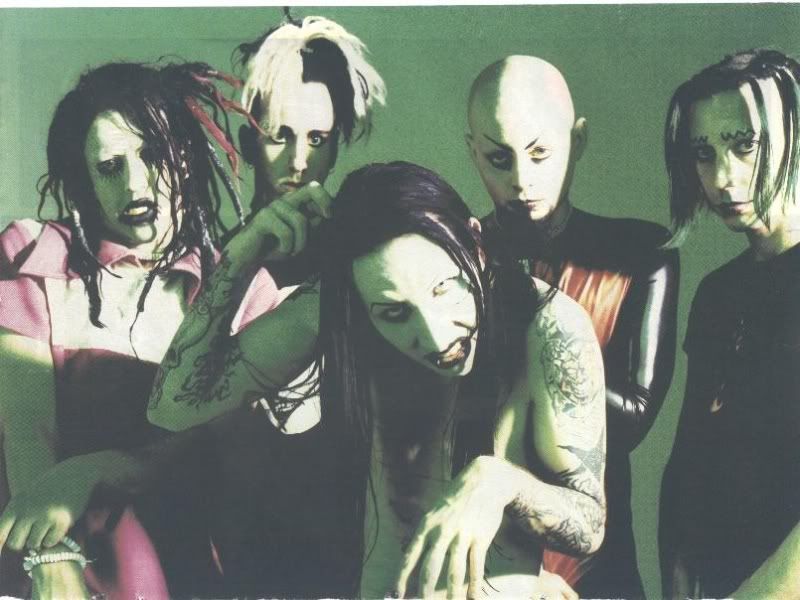


When I was attempting to relate Lord Byron to a pop culture individual, it hit me pretty fast. As odd and he may be, the one person I can relate to Byron, is Marilyn Manson (center front). It's pretty easy to see parallels between them. One of the main parallels is the "love of everyone" scheme Byron had going for him. Lord Byron was accused again and again of having "homosexual relations." Marilyn Manson has been accused since 1989 of having love affairs with bassist Twiggy Ramirez (back far left). He has also been accused of having affairs with drummer Ginger Fish (back second from left) and ex guitarist John 5 (not pictured). Manson has never refuted or agreed to any of these claims. His personal life has also had such problems. When formerly married to burlesque dancer Dita Von Teese, it was reported that he was having a love affair with his now girlfriend Evan Rachel Wood. Byron also generally had age differences between him and his "lovers." Manson was around 35 when he began dating Even Wood, who was 19 at the time. Marilyn Manson is also a ridiculous lover of animals (despite those awesome claims of sacrificing them, because he's stated many times how false that is :)), like Byron who was fully in love with his dog, Manson spends generally all of his free time with his cat. He also has donated money to many animal protection charities., or he said he has in his biographies. Also, Manson is a believer in freedom of oppression, he is a constant voice in the music industry about the government, and how they are treating society.

uno
dos
tres?
Sunday, February 10, 2008

Star Three. What was the cult of domesticity and what values did they uphold?

The Cult of Domesticity was a view in Great Britain and America that revolved around the middle class portion of women; women were seen as "homemakers" and existed in an entirely different sphere than men.

The main ideal, according to the Cult of Domesticity, for middle class women was that they were supposed to convey perfect virtue in every sense of the word. Women were automatically placed as the center of the domestic sphere. They fell into the customary routine of being a good mother and wife. They were required to be nurturing and calm towards their children, loving and faithful to their husbands, and all around virtuous. They were also deeply religious, they taught the people around them about their Christian values, and were given the task of inspiring their husbands into religion.

There were four main values that each woman was believe to have to uphold. The first value was piety. Piety means that these women were believed to be more religious than men. The second value was purity. They were required to be pure in heart, mind, and soul. The third value was submission; women were required to give in to whatever it was their husbands said. The men made all decisions and the women were required to go along with it no matter what. And the fourth value was domesticity. This was the belief that while the man was out making the living for the family, the woman was at home creating a nurturing domain for the children and for the husband to come home to.

Due to the nature of how women were supposed to act at home, they became the more suitable gender to become teachers. Women were already raising their children and taking care of their husbands, so they had the ideals and values set in to teach children how to progress in the world.

Victorian British mothers were sometimes referred to as "the angel of the house." She was responsible for the moral education of her children, and to keep her husbands morality. The woman had the task of keeping the household running harmoniously. She has the task of overlooking the accounts and directing the household's servants.

Outside of the house women had very limited options. If a woman was unmarried she could be a companion or a governess. Many middle class married women undertook voluntary charitable work, and protested for social reforms. Women also played a vital role in the struggle to abolish slavery and the slave trade within the British Empire. Women also ran wide ranges of movements into order to attempt to better society, they included improving conditions for the poor in schools and hospitals, the decline of prostitution, and factory hours for women.


http://en.wikipedia.org/wiki/Cult_of_Domesticity
http://www.library.csi.cuny.edu/dept/history/lavender/386/truewoman.html

AND

our book mainly
D:
:[

Sunday, February 3, 2008

Star Two. What main diseases were spread throughout Industrial Britain?

During the Industrial Revolution a fraction of the population were forced to work in the new factories to be able to support their family. Women and children were also now working in the factories in astounding numbers. Between the overcrowding of working space, unsanitary living AND working conditions, and pollution disease was able to make it's way through the cities and create complete devastation.
One of the main diseases during the Industrial Revolution was cholera. Cholera hit London so hard that it was known as "King Cholera." Cholera is spread through contaminated water, and during the Industrial Revolution there was plenty of that. People still generally received their drinking water from rivers so they were easily introduced to the disease. Rivers were contaminated mainly due to the fact that sewage water was allowed to flow into the rivers. With the population's immune systems already declining, cholera was free to spread quickly.
Britain was hit by cholera devastations multiple times. The first lasted from 1831-1832, the second wave lasted from 1848 to 1849, and then again in 1854 and 1867. It was documented that in the 1831-1832 outbreak in London around 7000 people died. That meant that cholera had a 50% mortality rate. In the 1848 to 1849 out break, however, 15,000 people died from "King Cholera."
Another disease to hit Industrial cities was smallpox. Most industrial cities were oblivious to the fact that Edward Jenner had created a vaccine for smallpox. This created a huge re-occurrence of the disease. With most of Britain's population centralized within the cities the disease could enter one city and kill a large population. The overcrowding enabled the disease to spread throughout both living quarters and places of work.
Typhoid and Typhus were both also common throughout the cities. Typhoid is a lot like cholera; it is spread through water or food that is contaminated by fecal matter. Typhoid is characterized, however, by an unnaturally high fever. Dehydration is a common symptom, and if not treated Typhoid can cause hemorrhaging of the intestines, and internal bleeding. Typhoid spread through the city of Croydon in 1852. The Board of Health began searching for a reason of the outbreak, however, they never thought the problem might be the sewage in the water. Typhus, on the other hand, is carried by lice. Rats and mice would carry the infected lice, which would then spread to the people. Rats were common in cities, and had been known to spread diseases before (such as the bubonic plague). Typhus was easily spread due to the overcrowding as well. Lice could easily move from person to person. Typhus was characterized by a rash that spread throughout the whole body. It was not discovered that lice were the carriers until the 20th century, which meant no real precaution could be taken towards Typhus during the 19th century.
While cholera, typhoid fever, and typhus all majorly affected the population, the greatest killer of Industrial Britain was tuberculosis, or TB. TB is highly contagious, it is easily spread by simply inhaling the disease that an infected person has breathed out. With (you guessed it) overcrowding, TB was able to take London by storm. TB easily affected the undernourished and close quartered, and those whom had damp homes. It is believed that TB killed around one-third of all of the British population that died from 1800 to 1850.

Alls I have to say is, medical advances ftw!


http://en.wikipedia.org/wiki/Cholera

http://en.wikipedia.org/wiki/Smallpox
http://en.wikipedia.org/wiki/Typhoid
http://en.wikipedia.org/wiki/Typhus
http://en.wikipedia.org/wiki/Tuberculosis
http://www.schoolshistory.org.uk/IndustrialRevolution/disease.htm
http://www.historylearningsite.co.uk/diseases_industrial_revolution.htm
http://universalfacts.blogspot.com/2007/06/industrial-revolution-and-public-health.html
http://www.pubmedcentral.nih.gov/articlerender.fcgi?artid=261680

Wednesday, January 30, 2008

"What was something that you witnessed or experienced in your life in the last year that made you happy?"

While everyone I'm sure expects me to write about Wesley or Bruce Wayne, I'm going to go totally off the wall for this one. I have tons of personal moments I'd like to indulge a little blogging with. Buuuut, I'd rather not people I see on a daily basis know them. Yes, I'd rather tell a complete stranger something than people I know. I know, I'm such a freak.


So.
On February 24th, 2007 (yeah I know! Almost a year ago). My best friend and I Jill (IDK my BFF Jill?) went to the Masquerade to see one of our favorite bands, Retard-o-bot play. It was my second Retard-o-bot show and the guys in the band are totally down to Earth and really friendly. Luckily for me they actually remembered me so I was pretty much "one of them" for the night. I hung out with Benny Normal, who plays keyboards and bass, for most of the night just sitting on the steps educating young smokers on what their habits were doing to their lungs and digestive systems. By the end of the night it was just me and Jill left, still hanging out with the band. We were sitting outside while they were packing their equipment in the trailer.
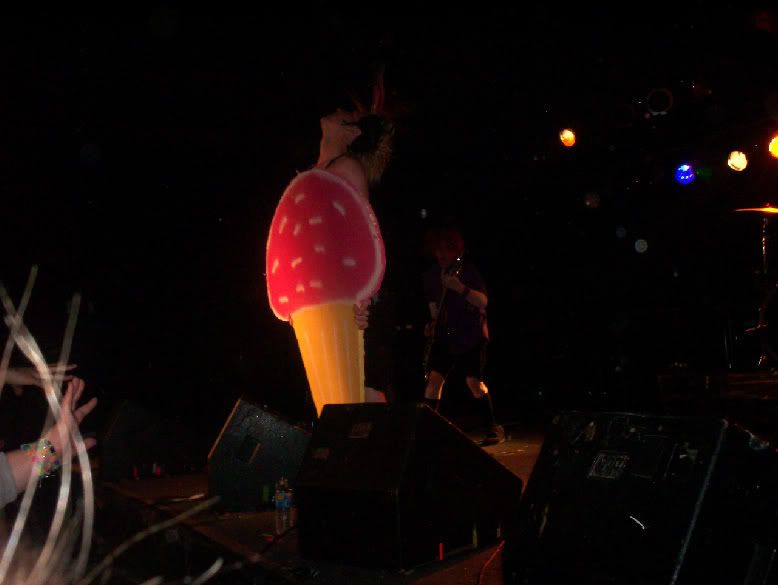
While Jill and I were sitting outside Benny came back over and sat down to talk some more. He looked at me and asked, "Did you get any of the keyboard?!" It seems like an odd question but the overly hyper keyboardist has an uncanny system of destroying all his equipment at the end of the show and showering the crowd with it. I informed the red headed psycho that no, I had not. "Considering you were at the other end of the stage and didn't migrate to our side." That's when Mr. Peter Pepper, singer of R-O-B, walked over to me with a stage prop. He held in his hands a giant pink Styrofoam cupcake. He placed the cupcake in my hands and walked off without a word. I assumed I was just holding it for him while he put something else in the trailer. So I asked Benny, "What exactly does he want me to do with it?" "I'm pretty sure he just gave it to you." Well, that was a surprise to say the least. When Mr. Pepper walked back towards our way I said, "Peter what am I doing with this?" Again, he said nothing and just moved his hands in my general direction apparently implying "it's yours." "You're giving it to me?" Once again, not one for words, Peter said nothing and just smiled really big and skipped off. No I'm not just saying that. He really did skip off.
The giant cupcake hung in my room above my bed for months, until I painted the walls. (Now it hangs in my closet). Every time I look at it it fills me with utter joy. My awesomely large and pink cupcake. That serves no purpose whatsoever.
An inanimate object that puts a smile on my face every time I see it, now there's true happiness.


Mr. Cupcake on stage with the Bots!


And there he is.
Large and in charge.

if you click them they get mighty bigger.

Sunday, January 27, 2008

Follow up to Star One.

The reason I was drawn to finding out about Churchill's writings was that he has always been my favorite politician. I had heard he had written books before, but never had known what genre and how many. So I figured now was a good of a time as ever to find out.
I think after experiencing the cruelty of war and the chaos it brings first hand really helped Winston as a leader. He was able to analyze not only the surface of war, but the underlying elements and the first hand experiences. After his involvement in war he could make better judgments as a leader. He could determine the seriousness of the situation, the general simulation of what could possibly happen, and decide if involving the United Kingdom would help more than it would hurt.
I would rather have a level headed leader that had experienced war. I say level headed simply because you cannot elect someone that is still emotionally devastated after war. And also, you cannot have a leader that is out simply for revenge for previous wars.
However, someone with knowledge of other countries tactics, and a clean slate that holds no grudges could be a good thing for a powerful country, like the US.
I do believe being a good writer is a powerful trait for a leader to have. They are then able to communicate their views to their country without just getting up and making a three hour speech that no one truly understands the point of. A book, however, has the availability for other leaders that will come after their time to study and analyze. It permanently imprints specific facts and views of the country into history. It also connects the leader to his people. It shows that he can take the time out of his "busy schedule" to create something that the entire nation can benefit from, other than tax returns, and creates a bridge from the mind of the leader to the mind of the entire population.

Star One. What was up with Winston writing?

Winston Churchill is most famously known for as being the British Prime Minister from 1940 to 1945 and again from 1951 to 1955. Churchill, however, was also an author during his life. When Churchill was twenty-four, he published his first on-fiction novel. It was titled The Story of the Malakand Field Force and was published in 1898. The novel is a detailed account of the 1987 military campaign on the Northwest Frontier, in which Churchill participated as a lieutenant in cavalry. In Malakand Field Force, Churchill describes the battle system of the Indians and the horror sights of seeing bodies piled six-foot high. The experiences in the Northwest Frontier gave Churchill a feel and more of a grasp than any other leader during World War II of trench warfare.
Churchill's second novel was titled The River War: An Account of the Reconquest of the Sudan and was published in 1899. Churchill also wrote this historic account while continuing to be an active military officer. The unabridged version contains many drawings, photographs, and colored maps of the areas of battle and all the territory surrounding it. The unabridged version also contains vivid narratives of Winston's personal adventures, his views on British expansionism, and passages of deep reflection of the requirements of a civilized government, criticism of military and political leaders. In 1902, when Winston became a member of Parliament, they felt that some of his opinions, beliefs, and statements should be edited out of the book for political purposes. Thus, the book was shortened to one volume, cutting out the "controversial" pieces of it.
In 1923 Churchill's next book was published, titled London to Ladysmith via Pretoria. The book is dedicated to the staff of the Natal Government railway. It is Churchill's personal accounts of the beginning five months of the Boer War. In 1899 Churchill had been captured as a war reporter. He then escaped and rejoined the army, going to Ladysmith to take Pretoria. Churchill and his cousin were two of the first military leaders to make it to Pretoria, and received the surrender of multiple Boer guards.
Churchill's next book was entitled A History of the English-Speaking Peoples. Churchill began writing it in 1937, however due to war and other of his compositions, it was not published until the years 1956 through 1958. The book began as a four volume historical account on the history of the "English-speaking people" and the American side of them. Since the United States had broken away from the crown they had created a division between the English-speaking people. The book dealt with the division, the causes, and the other nations that were still united under the crown. The fourth volume of the book was not completed until Winston was eighty. The four volumes of the text are titled: "The Birth of Britain", "The New World", "The Age of Revolution" and "The Great Democracies."
Winston's final book (that I'm talking about, he wrote around 25 apparently) is titled The Second World War. The book contains six volumes and is a historical account from the end of the First World War, until July of 1945. The book was opposed at first because a majority of the population saw him as a leader, and not an historian that was unbiased and able to cite nothing but facts.


and then we can't forget Churchill's famous V for Victory! pose.


sources
http://www.spartacus.schoolnet.co.uk/PRchurchill.htm
http://en.wikipedia.org/wiki/Winston_Churchill